

If your business runs on one AI model, your results can change on a day you did not pick. The name in the model picker stays the same. So does the price on your plan.
I went back through the record from August to this week: vendor status pages, product documentation, developer forums, and the reporting around them. I kept only what I could quote and link. Here is what it shows.
People call this “nerfing,” from the foam toy guns and the gamer habit of weakening a weapon in a patch. I am careful with the word. Tech Tomorrow put it well: “In every confirmed case so far, the model weights stayed the same and the damage came from a default that was lowered, a prompt that was tweaked or a bug that slipped through.” The Milwaukee Independent was just as careful: “There is only circumstantial evidence of a coordinated industrywide downgrade. But the timing is notable.”
For a business, that distinction does not change much. The work you planned on Monday came back different on Thursday, or did not come back at all.
What changed since August
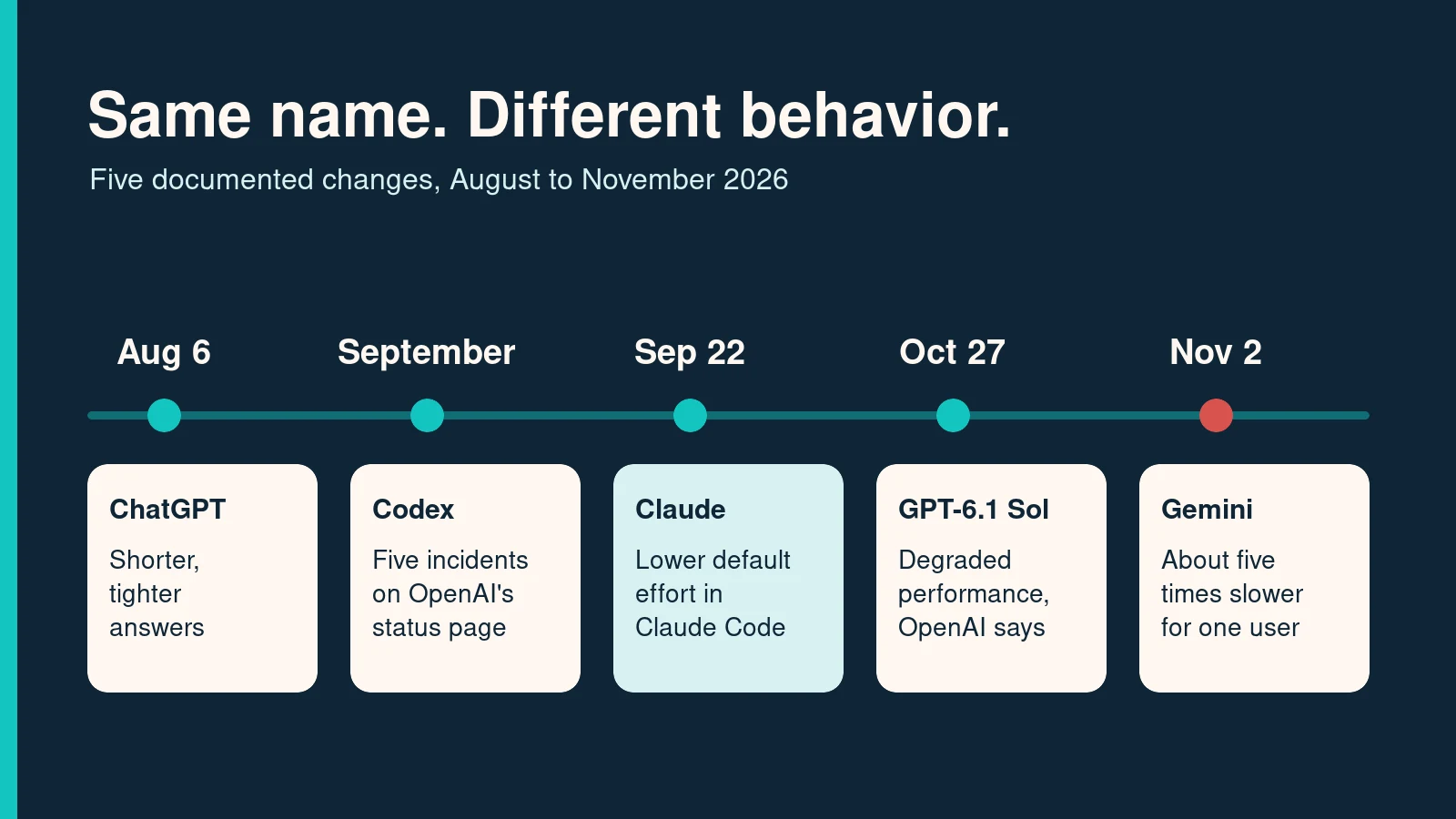
August 6: OpenAI made ChatGPT answers shorter
The Milwaukee Independent reported that OpenAI “changed GPT-5.6 Sol in ChatGPT on August 6, saying the update would produce more direct responses, tighter formatting, and less unnecessary detail.” The same release “also introduced a slider allowing users to choose how much thought ChatGPT puts into a response.”
That change was announced, not hidden. The paper also noted that OpenAI “separately markets GPT-5.6 Sol as delivering stronger performance per dollar, using fewer tokens, and lowering estimated cost.” Fewer tokens is a real engineering goal. It also means less work per answer. If your process depended on a long, careful draft, you had a different tool on August 7.
September: a rough month for Codex
In September, the month Anthropic released Claude Fable 5.1, OpenAI’s status page listed five incidents with Codex in the title. Three of them show the range:
- September 3: “Elevated errors across ChatGPT and Codex.” OpenAI’s write-up: “A routing configuration change prevented affected requests from reaching our services.”
- September 9: “Some Codex users may be experiencing unexpected usage limit resets.”
- September 25: “Issues with Codex,” marked as a full outage across Codex on the web, the API, the command line, and the VS Code extension. The write-up: “A false-positive security alert prompted an internal access change that prevented Codex from processing these requests.”
To be precise, these were outages and errors, not a quieter, weaker model. OpenAI fixed each of those three the same day and explained two of them. But a team that had moved its daily coding into one tool lost those hours, and had nowhere ready to send the work.
September 22: Claude Opus 5.5 shipped at a lower default setting
Anthropic released Claude Opus 5.5 on September 22. The Claude Code documentation says the default effort level is “high on every model that supports effort, except that Opus 5.5, Sonnet 5.5, and Haiku 5.5 default to medium and Opus 4.7 defaults to xhigh.”
CellCog spelled out what that meant for people upgrading: “A developer who had set high for Opus 5 and moved to Opus 5.5 runs at medium unless they chose again.” The documentation also describes a fallback. For Opus 5.5, “biology-flagged requests re-run on Opus 5, and cybersecurity-flagged requests re-run on Opus 4.8.” It adds: “After a fallback, the session continues on the fallback model.”
The setting made a measurable difference. CellCog cites AI Coding Daily’s October 20 scores for Opus 5.5: “67.26 of 70 at high effort, first on its board, 65.28 at medium and 60.5 at low.” The newer model was strong. The default hid some of that. Anthropic has been here before: in its April postmortem, as quoted by Tech Tomorrow, it called an earlier cut to Claude Code’s default effort “the wrong tradeoff.”
October 13 and 27: OpenAI reported degraded performance on GPT-6.1 Sol
On October 13, OpenAI resolved an incident with this note: “We have resolved the issue causing degraded performance with GPT-6.1 Sol in Codex and ChatGPT Work.” Two weeks later, on October 27, it opened another one titled “6.1 Sol Degraded Model Performance,” covering the Chat Completions, Responses, and Batch APIs for a little over an hour.
Credit to OpenAI for posting both. Neither page says what “degraded” meant or what caused it. If you were running client work on GPT-6.1 Sol that day, the status page was the only warning you got, and only if you were watching it.
October 15: Gemini 4 Argon limits ran out in a few prompts
TechCity Authority collected Reddit reports from paying subscribers soon after Google put Gemini 4 Argon in the Gemini app. One user “says one straightforward question used 5% of their session allowance on the Pro plan.” Another “says asking Argon (High) to explain a topic burned 48% of their limit.” The outlet calls these “individual, unverified reports.”
Google’s help page says Gemini app limits are “compute-based.” On October 13, Google’s Logan Kilpatrick wrote on X: “Argon is as “big model smell” as it comes, so limited on our ability to serve it widely, but working on versions of Gemini 4 which will be available to billions of people : )” That is an honest answer. It also means a model you cannot use for a full working day is a model you cannot plan around.
November 2: Gemini slowed to about a fifth of its usual speed
On November 4, a developer on the $99.99-a-month Antigravity plan posted on Google’s developer forum: “Right now both Gemini 3.8 Flash and Gemini 4 Argon are running at roughly 30 tok/s for me.” The slowdown, they wrote, “started in the afternoon of Nov 2.” They added: “I use Gemini specifically because it’s fast. It used to average around 150 tok/s for me, and that was the main reason I picked it over other models.”
A reply in the thread said “there is no throughput cap or throttling applied to 5x plan accounts,” that the drop “points to backend serving capacity or regional routing load rather than your account tier,” and that “we do not have a specific ETA to share yet.” The speed you chose a model for depends on capacity you do not control.
This week: a new model behind an old name
On November 2, TestingCatalog spotted GPT-6.2 Astra in Codex usage data and wrote: “The model picker still says GPT-6 Astra, so it looks like some requests are being quietly routed to the new model, either as an A/B test or the start of a staged rollout.” It added: “OpenAI hasn’t mentioned GPT-6.2 Astra anywhere.” Whether the new model is better or worse is not the point. The point is that the name on the screen may not tell you which model did the work.
And on November 8, Anthropic’s status page posted “Degraded performance for Claude Fable 5.1,” covering claude.ai, the Claude API, Claude Code, and Claude Cowork. The updates describe elevated errors, and the impact lasted 14 minutes. Short, but it reached the chat app, the API, Claude Code, and Cowork at the same time.
The one the numbers did not back up
Fairness matters, because this one cuts the other way. On October 24, Thariq Shihipar, a former Claude Code engineer, posted on X: “wait is it just me or is Opus 5.5 dumber.” CellCog counted more than 900,000 views by the next day.
The independent tracking did not back it up. LiveNerf, an open-source project that asks Opus 5.5 the same fixed questions through Claude Code every day, reported on November 8: “no change detected in Opus 5.5 on the frozen panel.” Anthropic has said the same thing in writing. In its September 2025 postmortem, it wrote: “We never reduce model quality due to demand, time of day, or server load.”
So sometimes the model really is fine and the feeling is wrong. That is the point. From inside one vendor’s product you cannot easily tell which it is. You need a second model to compare against, and you need to be able to move your work to it the same day.
Why your work should not be tied to one model
Every one of these changes had a reason. Cheaper answers, a busy data center, a configuration change, a security alert, a staged rollout. I do not think the companies are villains. I think their priorities and yours will not line up every week.
The real risk is not the change. It is how much you have to rebuild when it happens. The Milwaukee Independent described the trap: “Professional users accumulate prompts, files, integrations, habits, and institutional workflows around particular systems. Moving to another platform can require rebuilding months of work. A declining product can therefore retain customers even after its practical value falls.”
Most AI setups put the model at the center. The instructions, the saved prompts, and the connections all live inside one vendor’s app. When that vendor changes something, you either live with it or start over somewhere else.
How My Site Buddy handles a model change
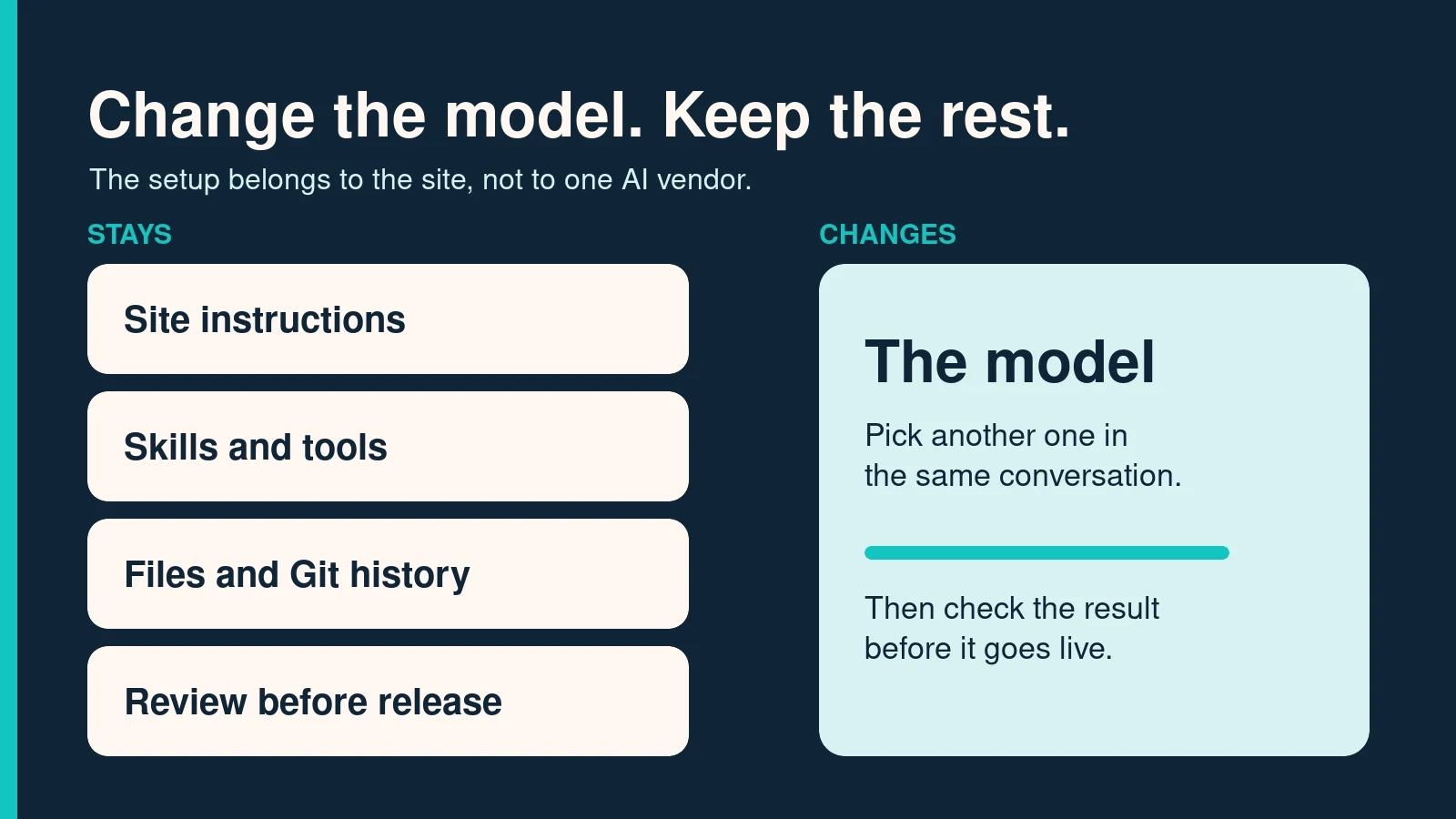
In My Site Buddy, the model is a setting on the conversation. You can pick a different one in the middle of the same conversation, and we offer models from more than one company. Here is what does not move when you do:
- The site’s instructions. Your brand rules, tone, standing preferences, and things like “never publish without my approval” are written down with the site. They are not inside a chat app you might leave.
- The skills and tools. The SEO checks, the accessibility audit, the ads review, and the connections to your accounts stay attached to the site.
- The files and the history. The site’s code and content are in Git. You can see what changed and who asked for it, whichever model drafted it.
- The review before release. Development is separate from production. Nothing reaches the live site until a person approves it. That rule does not depend on which model is running.
Switching models does not mean every model gives you the same answer. They write differently, and they make different mistakes. What it means is that you can try another model on real work in minutes, compare the drafts, and keep the one that holds up. You do that without exporting prompts, reconnecting tools, or teaching a new app your brand.
When a model has a bad week, you change one setting and keep working. When it recovers, you can change it back.
What I would do this week
- Write down the five tasks your business uses AI for most. A page edit, a blog draft, an ads review, a report.
- Save one real example of each, with an answer you were happy with.
- When a model feels worse, check the vendor’s status page and your effort or thinking setting first. Then rerun those five examples before you argue about it.
- Run the same five on a second model. If it holds up, you have a backup you have already tested.
- Make sure your instructions, files, and approval steps live somewhere a model change cannot take with it.
Your company’s tools should be able to change as fast as the AI market does. The model will keep changing. Your setup, your rules, and your review should not have to.
If you want your site work set up that way, Get moving.
Sources
- Jasmyne Jade Hill, “Why AI users report degraded quality as tech giants push reduced reasoning models to save costs,” Milwaukee Independent, September 6, 2026
- “Is Your AI Getting Dumber? What “Nerfed” Means, Why Claude and ChatGPT Really Do Change After Launch, and How to Test It Yourself,” Tech Tomorrow, September 30, 2026
- OpenAI Status, “Elevated errors across ChatGPT and Codex,” September 3, 2026
- OpenAI Status, “Investigating unexpected usage limit resets,” September 9, 2026
- OpenAI Status, “Issues with Codex,” September 25, 2026
- Anthropic, “Introducing Claude Opus 5.5,” September 22, 2026
- Claude Code documentation, “Model configuration”
- Nitish Garg, “Is Claude Opus 5.5 Nerfed? What the Trackers Measured,” CellCog, October 25, 2026
- OpenAI Status, “Degraded performance in GPT-6.1 Sol Codex and Work mode,” October 13, 2026
- OpenAI Status, “6.1 Sol Degraded Model Performance,” October 27, 2026
- TCA Staff, “Gemini 4 Argon users say limits run out after a few prompts,” TechCity Authority, October 15, 2026
- Google AI Developers Forum, Gemini 3.8 Flash and Gemini 4 Argon throughput thread, November 4–5, 2026
- “GPT-6.2 Astra appears in Codex usage ahead of possible launch,” TestingCatalog, November 2, 2026
- Claude Status, “Degraded performance for Claude Fable 5.1,” November 8, 2026
- LiveNerf, open-source Opus 5.5 drift study (README as of November 8, 2026)
- Anthropic, “A postmortem of three recent issues,” September 17, 2025