
CLM-8B is a contrastive language model built to rank possible actions instead of writing a paragraph. Researchers associated with Stanford and NVIDIA report that it can make some repeated AI-agent decisions faster. For a website team, the interesting question is not how quickly it picks an answer, but whether the right options and review steps were there in the first place.
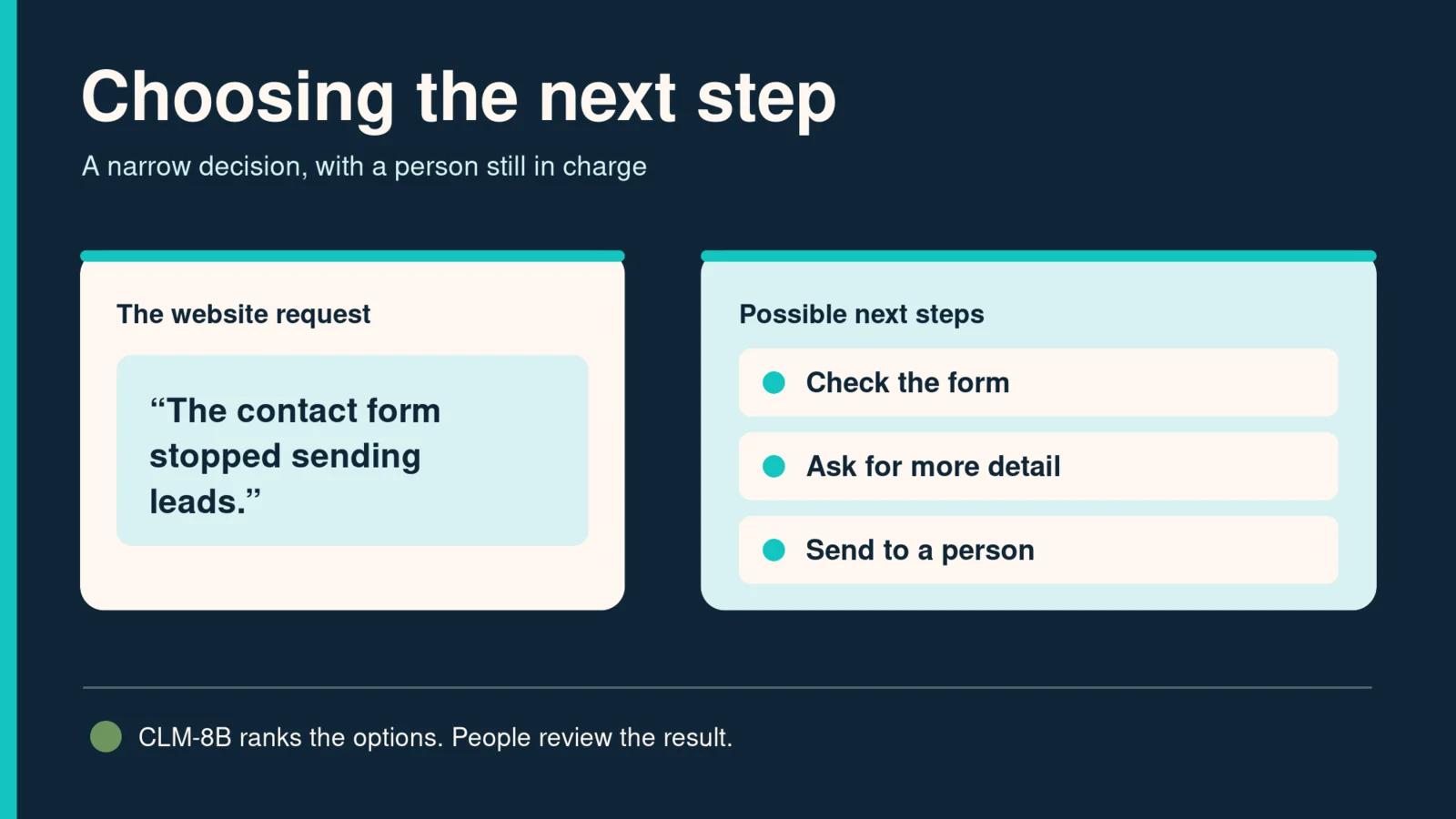
Picture a website request: “The contact form stopped sending leads.” The next step may be to check the form, ask for more detail, or send the issue to a person. You do not need a fresh essay to make that choice. You need a clear route and evidence that supports it.
How CLM-8B makes a bounded choice
The CLM project calls the current context a state and the available choices actions. CLM-8B turns each into a numerical representation, then scores which action best fits the state. During training, it learns to bring matching state-action pairs closer and push incorrect pairs apart. It does not write a new action or investigate the website on its own.
Its released model uses a frozen Qwen3-8B encoder with separate, smaller heads for states and actions. If a team keeps choosing from the same set of routes, the system can save the action representations and reuse them as new requests arrive. That is where the design can avoid repeated work. The model still needs to process new context, and changing the choices may reduce the benefit of caching.
The researchers trained it in stages: about 60 million question-answer pairs, about 30 million plausible but wrong answers, and about one million agent trajectories. Those figures describe the team’s training data, not decisions tested in a website workflow.
What the reported results do and do not show
In the researcher’s launch thread and model card, the team reports up to nine times lower latency than TypeSafe AI’s Jev on its zero-shot tests of games and tool calling. “Up to” matters: it is a best-case result from the tested settings, not a promise about every request. Reusing actions, or scoring many of them, is central to the reported speed advantage.
Speed is only one part of the result. VentureBeat’s reporting notes that CLM-8B matched Jev on two game tasks but trailed it on two other tests. On BFCL v4 tool calling, the reported scores were 95.2% for CLM-8B and 99.2% for Jev. In WikiRacing, CLM-8B completed 26 of 30 tasks; Jev completed all 30. A faster choice is not always the better choice.
The team’s coding numbers need another distinction. After fine-tuning, CLM-8B scored 81.6% on a 38-task DeepSWE subset and 87.6% on a 30-task Terminal-Bench 2.1 subset. Other models first generated several candidate solutions; CLM selected among them. These were small, held-out subsets, not evidence that the released zero-shot model can write and verify a complete software change by itself.
What a website team could test
A bounded decision layer could help sort repeatable work. For example, a team might ask it to choose whether a request concerns a broken form, a page edit, a tracking problem, or a person who needs to ask a follow-up question. Another test might rank draft responses against a supplied brief before an editor reviews them. These are possible uses, not My Site Buddy features or claims that we have tested CLM-8B in production.
We have already explored how typed decisions could help route website work. CLM-8B adds an interesting implementation choice: keep a known set of actions ready, score new situations against them, and compare the result with other approaches. It does not remove the need to gather accurate evidence or decide who may approve a change.
The missing option matters most
The model card states that CLM-8B only scores the candidates it receives. Its probabilities describe those candidates relative to one another. If all the options are wrong, a top-ranked answer can still look convincing. An explicit “ask for more information” or “send to a person” choice helps, but the team must test when that choice is selected and how errors are caught.
A sensible pilot would compare CLM-8B with simple rules and the team’s current routing process on reviewed examples. Measure wrong routes, useful deferrals, and response time with both fresh and reused actions. Keep website changes in development, show a preview, run checks, and require a person to approve any production release. A ranking score is not a permission to publish.
In short, CLM-8B is promising for narrow, repeated choices—not for replacing a careful website team. The real gain would be getting a request to the right reviewer sooner, while leaving the evidence, preview, and final decision easy to inspect.